
The new edition of ISO 22000 (Food Safety Management System) has been published

ISO 22000:2018 sets out the requirements for a food safety management system. It defines what an organisation must do to demonstrate its ability to control food safety hazards and ensure that food is safe for consumption.
The key changes are:
- Adoption of the High Level Structure, the common structure shared by all ISO management system standards, helping organisations to combine ISO 22000 with other management systems (such as ISO 9001 or ISO 14001) at any point in time,
- The new risk approach – as a vital concept in food business – which distinguishes between risk at the operational level and risk at the management system action level,
- The PDCA cycle – establishes 2 types of cycles, one for the management system and one for the HACCP principles
The new standard provides dynamic control of food safety hazards, combining the following recognised key elements: interactive communication, systems management, prerequisite programmes (PRPs) and the principles of hazard analysis and critical control points (HACCP).
ISO 22000:2018 vs ISO 22000:2005
| ISO 22000:2005 | ISO 22000:2018 | PDCA |
| 4. Food Safety Management System 5. Management Responsibility 6. Resource Management 7. Planning and Realisation of Safe Products | 4. Context of the Organisation 5. Leadership 6. Planning 7. Support | PLAN |
| 8. Validation, Verification and Improvement of the FSMS | 8. Operation | DO |
| 9. Performance Evaluation | CHECK | |
| 10. Improvement | ACT |
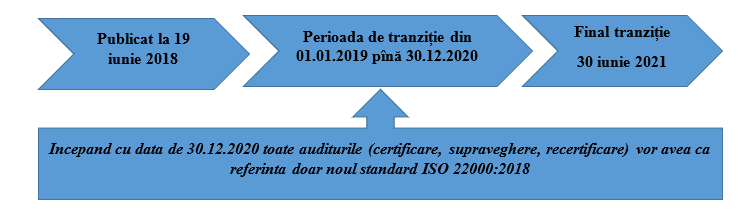
TRANSITION TO ISO 22000:2018
For more information visit the official ISO website https://www.iso.org/home.html.